




Have Questions?
-
Australian Owned & Operated
-
Technical Support
-
Easy Returns
-
fast & Free Shipping
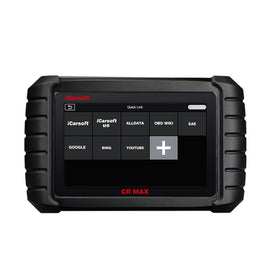
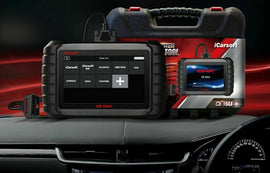
New iCarsoft CR V3.0 Professional Car Diagnostic Scan Tool Suit Multi-Brand Car
🧠 ICARSOFT CR GENIUS – Deep Technical Description
1. ⚙️ System Architecture (What the device fundamentally is)
The ICARSOFT CR GENIUS is a handheld embedded diagnostic computer built on:
- Android 8.1 OS
- Quad-core ARM processor (1.3 GHz)
- Touchscreen HMI (Human Machine Interface)
What this means technically:
It is essentially:
A portable ECU communication terminal running diagnostic software stacks over OBD-II protocols.
It combines:
- Operating system layer (Android)
- Diagnostic application layer (ICARSOFT software)
- Vehicle communication interface layer (OBD-II + manufacturer protocols)
2. 🔌 Vehicle Communication Layer (Most important part)
The scanner communicates through the OBD-II port using standardized protocols:
📡 Supported Protocols:
- CAN (Controller Area Network) → modern vehicles (2008+ mostly)
- ISO 9141-2 → older Asian/European vehicles
- KWP2000 (Keyword Protocol 2000) → mid-era European cars
- J1850 VPW / PWM → older US Ford/GM systems
🧩 What this actually means in practice:
Each protocol defines:
- How ECU messages are formatted
- How requests/responses are structured
- How timing and handshake occur
So the device acts as a:
Protocol translator between human-readable commands and ECU binary communication frames
3. 🧠 ECU System Access (What systems it can talk to)
Modern cars are not one computer — they are multiple ECUs:
The tool communicates with:
- Engine Control Module (ECM)
- Transmission Control Module (TCM)
- ABS / ESP module
- Airbag system (SRS)
- Body Control Module (BCM)
- HVAC systems
- Steering systems
- Diesel aftertreatment systems
🧠 Technical interpretation:
It performs:
Multi-node CAN bus scanning + module addressing + response decoding
Each ECU responds independently over the vehicle’s network.
4. 🔍 Fault Code Diagnostics (DTC System)
📌 DTC = Diagnostic Trouble Code
The scanner performs:
1. Read DTCs
It sends a request:
“Give stored fault memory”
ECU responds with:
- P-codes (Powertrain)
- B-codes (Body)
- C-codes (Chassis)
- U-codes (Network communication)
2. Clear DTCs
It sends:
“Reset memory / erase stored faults”
ECU then:
- Clears non-permanent faults
- Resets warning lamps (if conditions allow)
3. Pending & Permanent codes
- Pending = intermittent fault detected
- Permanent = verified fault stored for emissions compliance
5. 📊 Live Data Streaming (DataStream)
This is real-time ECU telemetry.
Examples of data parameters:
- Engine RPM
- Injector pulse width
- Fuel trims (STFT/LTFT)
- O2 sensor voltage curves
- Coolant temperature
- Mass airflow (MAF)
- Throttle position
🧠 Technical explanation:
The tool continuously polls ECU using:
PID (Parameter ID) requests over OBD-II Mode 01
Then:
- Parses binary responses
- Converts to human-readable values
- Updates UI graphically
6. 📈 Graphing Engine (Data visualization layer)
It converts raw sensor data into:
- Time-series graphs
- Analog gauge simulation
- Numeric streaming
Why this matters:
It helps detect:
- Sensor lag
- Signal noise
- Intermittent dropouts
7. 🧪 Bi-Directional Control (Active Testing System)
This is one of the most advanced features.
Instead of just reading data, it can send commands:
Example ECU commands:
- Activate fuel pump relay
- Turn radiator fan ON
- Cycle ABS pump
- Open/close EGR valve
- Trigger injector pulse test
🧠 Technical meaning:
This uses:
UDS (Unified Diagnostic Services) / actuator control routines
It essentially tells ECU:
“Execute function X under test mode Y”
8. 🛠️ Special Function Modules (Service Algorithms)
These are guided ECU adaptation routines, not just simple resets.
🔄 SAS Calibration
Resets steering angle zero-point:
- Writes baseline offset into steering ECU memory
🅿️ EPB Service Mode
- Sends actuator retract command
- Forces caliper motor into maintenance position
🌫️ DPF Regeneration
Triggers:
- High-temperature exhaust cycle
- ECU-controlled fuel injection post-burn
🔋 BMS Battery Registration
Writes:
- Battery capacity
- Charge acceptance parameters
- Aging reset values
⚙️ Throttle Relearn
Resets:
- Idle air control mapping
- Throttle position sensor adaptation curve
🛑 ABS Bleeding
Runs:
- Hydraulic pump activation cycles
- Valve opening sequences
⛽ Injector Coding
Writes injector ID values into ECU:
Ensures fuel delivery compensation per cylinder
9. 📡 Freeze Frame Data (Fault Snapshot System)
When a fault occurs, ECU stores:
- Engine load
- RPM
- Temperature
- Speed
- Fuel conditions
🧠 Technical concept:
This is a:
time-stamped ECU state buffer triggered by DTC event flagging
10. 🌐 Auto VIN & Vehicle Identification
Uses:
- Mode 09 OBD request
- ECU identification registers
Automatically detects:
- Make
- Model
- Year
- Engine type
11. 🧾 DTC Database + Interpretation Layer
The scanner includes:
- Internal fault code dictionary
- OEM-style descriptions
This is essentially:
A local embedded knowledge base mapping hexadecimal ECU codes → human readable diagnostics
12. ⚡ Performance & Limitations (Engineering Reality)
Strengths:
- Wide protocol compatibility
- Multi-ECU coverage
- Strong service functions
- Good for workshop-level diagnostics
Limitations:
- Not full OEM-level programming tool
- Some coding/adaptation functions restricted
- Vehicle coverage varies by model year
- Advanced ECU flashing not supported
🧩 Final Engineering Summary
The ICARSOFT CR GENIUS is best described as:
A multi-protocol automotive diagnostic and actuation terminal that interfaces with vehicle ECUs via OBD-II, interprets diagnostic data streams, and executes guided service routines through manufacturer-defined diagnostic service modes.
